The Art Metalwork Designs of Marie Zimmermann


Metalworker, designer, and jeweler Marie Zimmermann (1879–1972) was known to her inner circle as “Mitey,” a nickname perfectly suited to her pioneering spirit. Her small stature belied a forceful personality characterized by creativity, curiosity, and innovation, traits well suited to a career spanning the opening decades of the 20th century.
Zimmermann began her professional life as a jewelry designer, rapidly expanding her oeuvre to include a wide variety of ornamental objects for the home and garden. Period journalists dubbed her “Master of a dozen crafts” as she worked with wood, iron, brass, bronze, copper, aluminum, steel, ivory, gold, silver, enamel and jewels, experimenting with confidence in each material.
Zimmermann studied metalworking at the Pratt Institute in Brooklyn but began her professional artistic training at the Art Students League in Manhattan where classes in drawing and modeling influenced her design process for the remainder of her career. She used her fine art training to sculpt objects in three-dimensional wax models before sending a candelabra or a maquette of ornate mausoleum gates off to be cast in the traditional lost wax method at the Roman Bronze Works foundry.

Marie Zimmermann modeling Ward-Thorne crypt gates in her studio, circa 1924. Silver gelatin print, Courtesy of The Marie Zimmermann Archive
Although briefly affiliated with New York’s Pen and Brush Club and Boston’s Society of Arts and Crafts, in 1901 Zimmermann joined the National Arts Club in Gramercy Park at twenty-two years of age as an artist in applied art, jewelry, and metalwork, eventually becoming a lifetime member in 1913. Her suite of rooms included private living spaces, an active studio, and a showroom brimming with her designs where she conducted client business and gave interviews to journalists. Within these walls she learned aspects of running a business, planning, and promoting exhibitions of her work and filing patents to protect her designs. Inside her atelier she immersed herself in the design and creation of a remarkable variety of decorative objects ranging from delicate jeweled ornaments and gold-plated tableware to designs for memorial commissions and garden rooms. Her ability to design to any scale caused a friend to remark that “Mitey” made everything from tiaras to tombstones.

U.S. Patent filed in 1922 for a Spoon or Similar Article, Marie Zimmermann, Inventor
Affection for the natural world is one of few themes connecting Zimmermann’s eclectic body of work. Her love of the outdoors began at her childhood home in Brooklyn and her family’s country house in Milford, Pike County, Pennsylvania where she enjoyed horseback riding, camping, hunting and fishing. Toward the end of her career, she contributed an article to Arts and Decoration magazine in 1940 quoting Goethe and stating simply, “Nature and art cannot be separated with out destroying art as well as life.” The influence of nature is at the forefront of her Asian-inspired floral-form bowls and lotus motifs appear in many of her tabletop and jewelry designs. She demonstrated her ability to design to any scale by prominently incorporating lotus leaves and blossoms into a monumental commission for bronze doors created for the family vaults of A. Montgomery Ward and his brother-in-law George R. Thorne, installed within a Rosehill Cemetery Mausoleum in Chicago. In correspondence with a member of the immediate family, Zimmermann compared the construction of these gates to building “a great big piece of jewelry" providing insight into the way she conceived and approached a design.
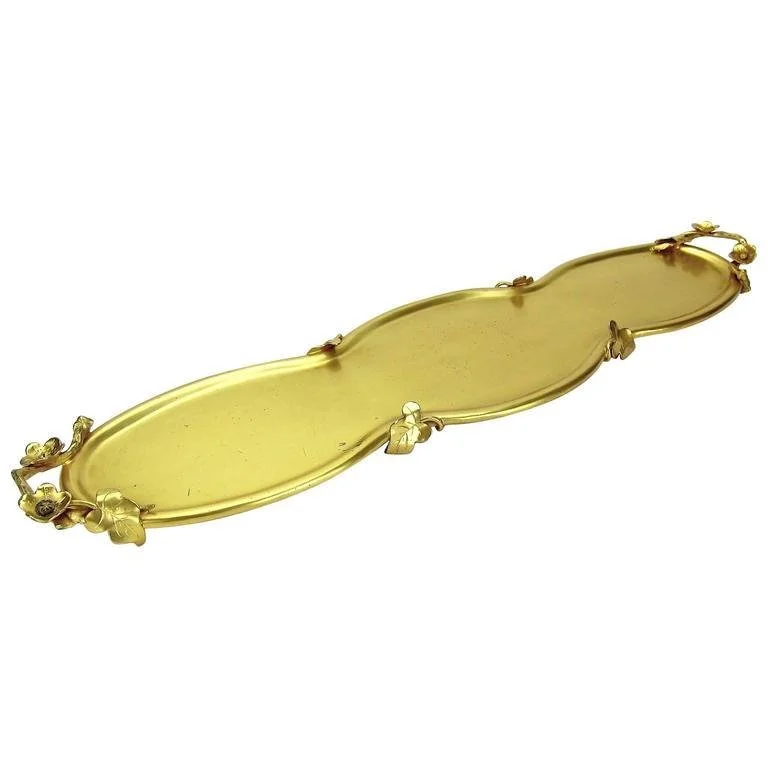
Large silver gilt tray in Art Nouveau Style by Marie Zimmermann
Zimmermann did not mark her ironwork and only a small fraction of her jewelry bears her logo. She stamped many of her smaller base metal designs with an MZ logo in a circle (or a double circle) surrounded by MARIE ZIMMERMANN MAKER or MZ MAKER, at times with a model number with an addition of STERLING on her silver objects.
Zimmermann possessed an affinity for historical style and referred to her designs using cultural designations including Egyptian, Persian, Celtic, Babylonian, Etruscan, and Venetian. Her talent lay in an ability to interpret and transform these influences into idiosyncratic adaptations that were completely her own. At times she employed her skills as a jeweler to incorporate gemstones or carvings into her designs, using intriguing “found objects” as handles, finials, or simply as ornament. Her boxes and covered vessels were often finished with an antique cameo, Baroque pearl, Chinese hat finial, Japanese netsuke, Egyptian scarab beetle or a slice of antique jade. Generally, she acquired these embellishments—as opposed to designing them herself—using these visual clues in concert with an object’s color palette to convey a cultural or historical point of reference.
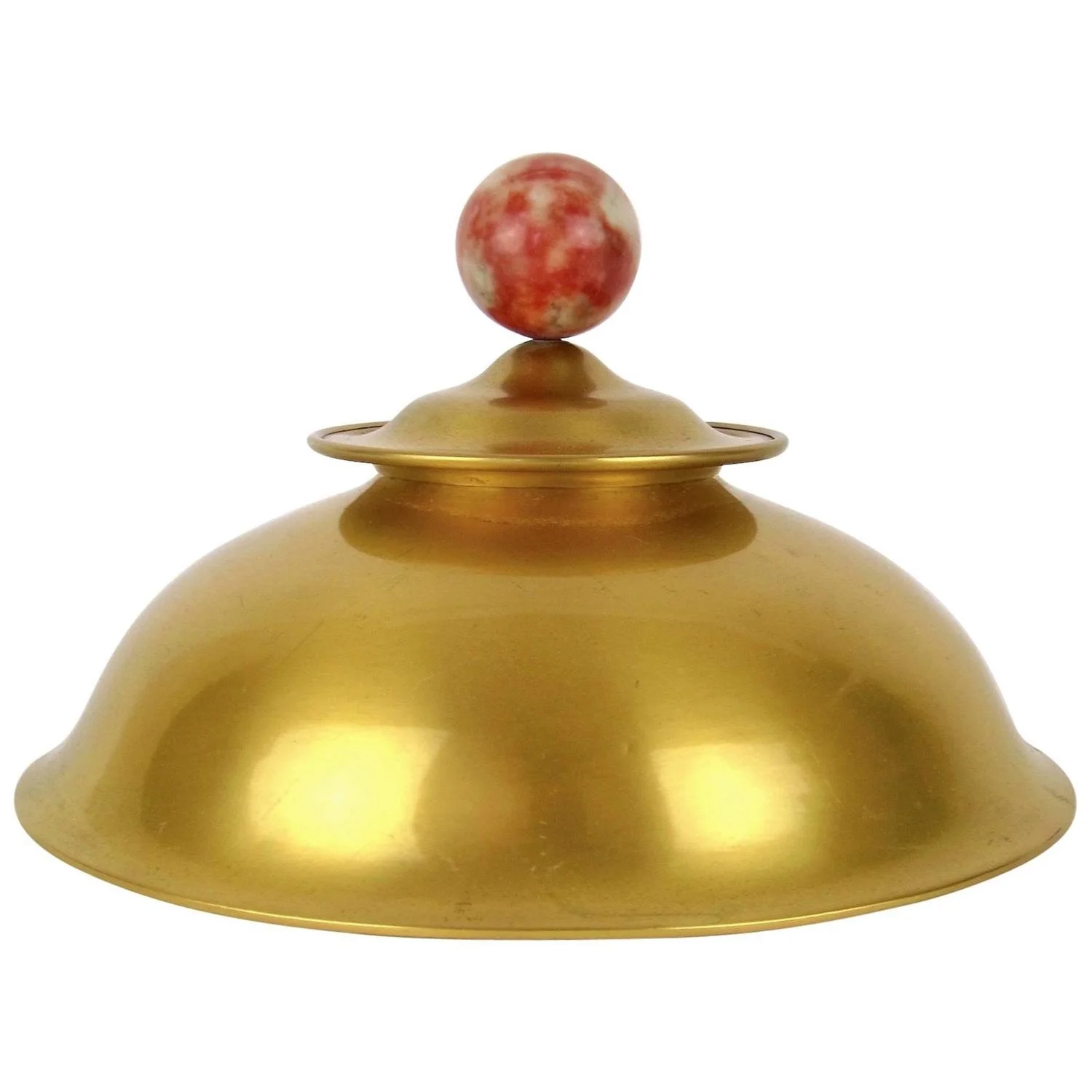
A large inkwell of gilded copper with a contrasting carved coral and white stone finial by Marie Zimmermann
Imaginative use of color allowed Zimmermann to enhance or subvert the origin of a formal precedent and her work with surface treatments as ornamentation produced her most distinctive and original designs. She embraced the English Arts and Crafts movement’s preference for enameling as ornament and particularly favored the Egyptian Revival palette of red, blue and green. Experimenting with ancient encaustic techniques combining pigments and hot beeswax allowed her to build up rich layers of color on wood to achieve lustrous polychrome surfaces. She was capable of expertly disguising her materials with a remarkable variety of patinas achieved through gilding and electroplating or the use of heat, chemicals and pigments. Zimmermann was equally concerned with preserving the surfaces of her carefully finished objects. She used varnish to seal in color and was an early advocate of a process she called “Rhodenization,” a plating process used to prevent silver from tarnishing. Rhodium plating is widely used in today’s jewelry industry due to the material’s hard, highly reflective, and non-oxidizing properties.
Zimmermann began to wind down her career after a series of family tragedies in the 1930s, refusing exhibition requests from the Metropolitan Museum of Art, the Philadelphia Art Alliance, and the Honolulu Academy of Fine Arts. She spent increasing periods of time away from the city, writing a former client in 1941 that she was retired and spending most of her time in the country. She enjoyed hunting, shooting, and fly-fishing in the company of close women friends including her longtime companion, Ruth Allen and moved between her residences in Manhattan, The Farm in Pike County Pennsylvania, and in Florida before dying at her home in Punta Gorda on her ninety-third birthday.
Zimmermann exhibited her objects across the country and today, her designs are included in the public and private collections throughout the United States. The Metropolitan Museum of Art in New York City holds the largest collection of Zimmermann’s jewels and metalwork, acquiring their first example in 1922.
Zimmermann’s objects can also be found in the following collections:
Museum of the American Arts & Crafts Movement
Los Angeles County Museum of Art
Wolfsonian-Florida International University
Columbus Museum of Art
The Huntington
Edsel & Eleanor Ford House
Shelburne Museum
For additional information about Marie Zimmermann’s life and work, please see The Jewelry and Metalwork of Marie Zimmermann, American Decorative Art 1900 Foundation and Yale University Press, 2012.

Three vases in copper, sterling silver and with an encrusted green patina by Marie Zimmermann